
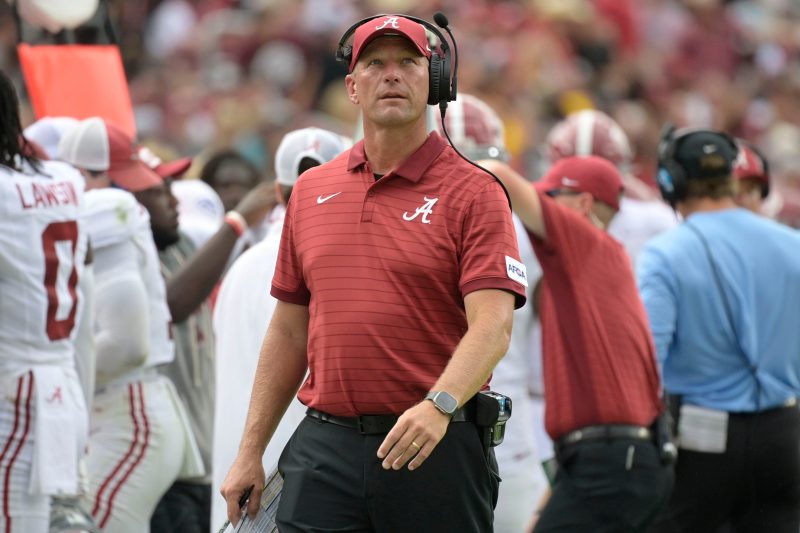
You cannot deny the risk. You can’t ignore the opportunity, either, for Kalen DeBoer and Alabama against No. 1 Indiana.
Indiana built from transfer portal fires. Alabama is more traditional, leaning on high school recruits.
Hoosiers’ success shows how Nick Saban perhaps misjudged the transfer portal.
You cannot deny the risk. You can’t ignore the opportunity, either.
Both exist for Alabama coach Kalen DeBoer inside this College Football Playoff quarterfinal matchup with No. 1 Indiana at the Rose Bowl.
If Alabama falls, particularly if it falls hard, then DeBoer’s Year 2 will be sullied. The second campaign as Nick Saban’s successor will be remembered as much for its bookends — an opening loss to Florida State and a playoff exit — as it will for the achievements in between.
That’s the risk.
The opportunity? A takedown of Curt Cignetti’s top-ranked Hoosiers would count as DeBoer’s most impressive triumph in two seasons at Alabama.
DeBoer already has beaten Kirby Smart twice. He’s 2-0 in the Iron Bowl. His Tide engineered an unlikely comeback to topple Oklahoma in a playoff game. He’s got pelts on his wall, but upsetting Indiana in the Rose Bowl would be a 16-point trophy buck.
Never mind Indiana’s history as a former basketball school and a longtime football doormat. The Hoosiers transformed into a Big Ten bully with a hotshot coach who’s proving success in this world of NIL and transfer free agency is not limited to blue bloods.
“He’s done an awesome job,” DeBoer said of Cignetti.
Has he ever.
Indiana being a seven-point favorite in a playoff game against Alabama speaks to college football’s remarkable, warp speed evolution.
Nick Saban perhaps misjudged transfer portal effect
It also underscores how Nick Saban once miscalculated the transfer portal.
In 2021, the NCAA altered its rules to allow undergraduate transfers to play immediately for their new school instead of having to sit out for a season. I asked Saban what he thought about that rules change.
“Is that going to make the rich get richer?” Saban, Alabama’s coach at the time, said then. “I don’t know. You can decide that.”
Saban didn’t answer his rhetorical question, but he seemed to imply the transfer rules change would benefit the haves more than its have nots.
The transfer portal, Saban surmised back then, would be filled with “bad players” who were unable to gain playing time on good teams, while blue-blooded programs like Alabama would cherry-pick top transfer talent.
Months after the transfer rules changed, another major evolution arrived. The NIL spigots opened for the first time.
Years later, we can see within this playoff field that the arrival of NIL, plus transfer free agency, did not kneecap blue bloods. Ohio State is doing just fine. Georgia and Alabama are still standing. But, they’re not hoarding talent to the degree they once did.
Schools like Indiana, Mississippi and Texas Tech are scooping up capable players, too, much of it acquired from the portal.
So, did the rich get richer?
Well, consider Indiana’s 24 victories the past two seasons match its total from a six-year span from 2007-12.
That’s not a case of the rich getting richer. That’s a longtime pauper hitting the lottery.
Indiana surpassed Alabama with transfers
Cignetti’s past two recruiting classes adhered to Indiana’s historical norms for signing mostly three-star prospects, but the portal’s elixirs greased the wheels for an uprising. Indiana assembled deep transfer hauls in each of the past two offseasons. Cignetti got the most out of those inbound players.
Among teams remaining in the playoff, Ohio State, Georgia and Alabama are built mostly with high school recruits, although the Tide also possess several high-impact transfers.
Ole Miss, Indiana and Texas Tech feature the most transfer-laden rosters.
Oregon and Miami fall in the middle of the two ends of the spectrums, with the most evenly blended rosters.
Risk meets opportunity for Kalen DeBoer
Alabama fans are smart enough to realize the sport takes a much different shape today than it did when Saban forged his dynasty, but they’re demanding enough that DeBoer can’t expect them to be satisfied with a four-loss season, if it ends in the quarterfinals at the hands of Indiana.
Twenty years ago, or even five years ago, Alabama wouldn’t be playing in this game. Playoff quarterfinals didn’t exist. A team with Alabama’s resume would be playing in something like the Citrus Bowl and not at risk of getting clubbed by the nation’s only undefeated team.
A New Year’s Day bowl game would have been accompanied by less risk back then. Less opportunity for reward, too, and no hope for a national championship. If Alabama can upset Indiana, that’ll offer evidence the Tide can play with anyone in this bracket. DeBoer would mount another pelt on his wall, with a chance for more in the rounds to come.
Risk and opportunity will coincide when Alabama faces a burgeoning football program from a basketball state, built by Cignetti in a way that showed there’s room for the nouveau riche in this evolved landscape.
Blake Toppmeyer is the USA TODAY Network’s senior national college football columnist. Email him at BToppmeyer@gannett.com and follow him on X @btoppmeyer.